During the third consultation, many concerned residents asked Berkeley questions about the development. Some were answered, yet others remain very much unanswered. The following summary is based on the feedback we have received. It is not in any thematic order.
The consultation process
There was a perception of poor consultation with the timing and location of the in-person consultation(s): lack of invitations, short notice, difficult to get to, time of day, school holidays, etc. A variety of reasons were given to residents for this: lack of venues, continuity, keeping to a schedule. The online consultation and survey were also seen as phrased in a way that is weighted in favour of the development.
Berkeley’s claim that they “work with existing communities” has not matched the expectations of any of our communities. We have very little idea of what stakeholder engagement has taken place, or the outcome of this. Despite New Malden and Lower Morden appearing on the developer’s literature, due to their services and amenities, these communities did not appear to get invited to any consultations.
Berkeley has stated that they “will be undertaking further engagement and will be back in touch by early September to discuss the points raised at the most recent consultation”.
Access to Kingshill Avenue
Kingshill residents are of the opinion that they own the land behind and next to their properties, which Berkeley would like to use for site access. This is causing considerable concern to Kingshill residents. At the in-person consultation, one resident was promised that Berkely would be in touch about the matter.
Question: Will Berkeley homes be engaging any time soon with Kingshill residents to give clarity on this?
The southern access road
This route looks very narrow for two cars and safe cycle/pedestrian access.
Question: Do Berkeley’s plans involve straying on to the above mentioned Kingshill land and / or Sutton land?
The woodland
Berkeley says they are going to improve the existing woodland.
Questions : What does Berkeley mean by ‘improve’, and which woodland are they referring to? The woodland within the gas holder site, the woodland within the allotments, or Sir Joseph Hood Memorial Wood? If the latter two, are Berkeley in conversation with Kingston or Merton Councils about their respective woodlands?
Building scale, height and visual impact
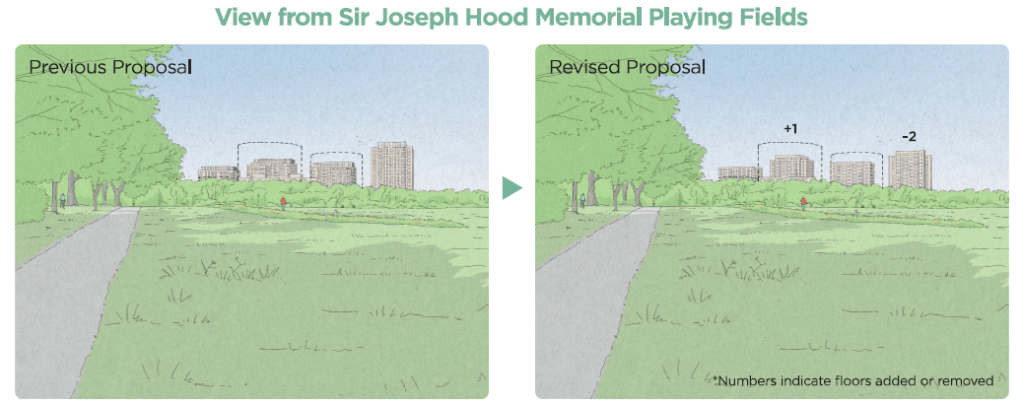
Many residents have commented that changing the height does little to address the impact on the visual character of the area. Both views are much the same, even with the revised proposals. Some residents queried the choice of views, and how many people experienced the gas holders from other vantage points. The ‘treeline’ has often been referenced as an appropriate height.
Questions: Should building scale, size and footprint be looked at, as well as height, to address peoples’ concerns about the visual character of the area? Can Berkeley please provide some different drawings, with views from the vantage point of impacted residents, such as Kingshill Avenue and Marina Avenue?
Affordable housing
Various people questioned what “affordable” meant. It was stated that 200 of the dwellings would be affordable, of which 100 would be social (council) housing and 100 would be affordable (i.e. sold to housing associations either for rent at below market rents or for part-purchase/shared ownership as starter homes). All the dwellings would be made to the same standard/specifications and would look the same.
Unit Mix
We were not told about the unit mix in any consultation. The following information was provided in an email from Lichfields post third consultation:
Studios: 40 (7%)
1 bed homes: 200 (34%)
2 bed homes: 295 (50%)
3 bed homes: 55 (9%)
Access to Marina Avenue
Pedestrian access through Marina Avenue seems to have been badly added to a survey on controlled parking. However, it is not properly included in all of Berkeley’s plans.
Question: Why were the residents of Marina Avenue not properly consulted on this?
Architecture
There were no positive comments received about the design, with one resident stating it was “essentially a rectangle with uniform square windows …an incredibly uncreative rectangle.” Another resident took a different, more long term-view: “Today’s fancy high-rises are often tomorrow’s dilapidated tower blocks!”
“When asked how this building fitted in with anything in the surrounding area, and where in the surrounding area are there any 18 storey buildings, they mentioned the incomplete Tesco development.” The Tesco development is in a commercial area, in another neighbourhood, and in another borough, where other flats already exist.
“The proposal for 5 buildings up to 16 storeys represents a fundamental mismatch with the surrounding area’s character, which consists predominantly of 2-3 storey terraced housing”
One resident said “(they) spoke to a Design Review Panel who requested that they make the buildings narrower but taller to give a sense of ‘openness’ within the development. We made the point very strongly that the development is surrounded by ‘openness’ and it was more important to preserve that!” Many residents commented on the current visual transparency of the site as opposed to the buildings – yes, the gasholders are tall, but you can see through them.
‘Living in the woodland‘
The architect seemed to want to talk about this concept, which was introduced at the second consultation. A number of residents have commented on the need to protect the woodland and are concerned about the proximity of the buildings to the wood’s wildlife. The idea of a bridge in the centre of the development / wood, that would mostly be of benefit to Berkeley’s sales and marketing team, is a red line for many residents.
Public Transport
A number of people commented on the statistics being quoted. Many mentioned that times for the assessment of public transport load have avoided what is potentially the busier period: 7am to 8am. Are those people commuting 3 days per week evenly distributed across the week?
One resident observed “I’d also love to know what method of getting to work those 11% of people are using who are not driving, not a passenger in a car, not catching a bus, not walking and not riding a bike…”
The service of the K5 bus was raised. It only operates weekdays, during the day and is a single-decker. The 131 bus is located on the wrong side of Motspur Park.
TFL could in theory request a levy for enhanced transport, however, SWR is under the national government’s control. Berkeley estimate an extra 30 people per train in morning peak hour but have been unable to say if SWR is prepared to increase services.
London, but what about Surrey?
One resident has made a point that all the information presented is about London and does not include Surrey. The development is a greenfield and brownfield site, and is being associated with London, when it is not urban in the same way. It involves two Boroughs that form part of Green Belt with Surrey. One bus that runs through Worcester Park has nothing to do with TFL. Flooding along the Beverley Brook is also a Surrey Council matter.
Roads and traffic
This was by far the area where we received the most comments and people would like more clarity. Many centered on the traffic survey, the modelling and data. It appears that a traffic survey was carried out on 3rd July.
One resident is of the opinion that Councils should fund proper independent traffic surveys. These should be the full length of Green lane and the relevant Motspur Parks roads, over several seasons, including winter, and at times of peak term time traffic flow. These should be recharged to the developer.
The representative from Iceni stated that they would be using TFL data from other developments as a proxy, to inform their estimates of expected traffic. They would also be including the new Tesco development in the modelling. However, he was not willing to disclose this data, and said it would be provided as part of the planning application.
At the consultation they suggested max extra 26 cars 8am-9am. One attendee did some very quick calculations:
- Average of 6m per car = 156m potential additional tailback down Green Lane
- If 3 cars go through per green light, 9 traffic light changes required = potentially an additional 15-18 minutes stuck in Green Lane.
Berkeley feel that the additional cars from the development will have little impact on Green Lane or Central Road traffic. However, they have stayed rather quiet on delivery vehicles, taxis and motorcycles for a development that has so few parking spaces. Sutton Council have also said very little on the matter.
Construction traffic v completion traffic
Construction traffic is expected to be via a one way system, with lorries entering from West Barnes Lane and exiting via Green Lane. Upon completion, all vehicular traffic will be via Green Lane from the southern access route. The northern access route will become pedestrian and cycle only.
Apparently Berkeley do not think the HGV restrictions on surrounding roads will be a problem.
Berkeley Homes say they will set up a Community Liaison Group with local residents and stakeholder groups to ensure there is dialogue during construction.
On site parking
The representative from Iceni stated that the 90 parking spaces were not based on traffic projections but on parking considerations, on and off site. One person was told that these would be sold separately to the flats. Another that 3 bedroom flats would have priority. 18 spaces will be reserved for disable for residents.
Off-site parking and CPZs
Many people have commented on the figure quoted of 47% of Londoners not owning a car, which is apparently a London wide statistic, including inner boroughs. One resident emailed us with TFL data (2023-24) which shows 62% of inner London homes are car free, and outer London as 33%. Another person looked at Kingston, where on average 26% of residents don’t own a car.
There are still unanswered questions about the unadopted section of Green Lane outside the school, and how this will be enforced and controlled. The CPZ survey does not seem to have included the Sutton residents, but did highlight these areas as a proposed CPZ. Berkeley have since said that this is not a concern as it is too far from the development, despite parts of Kingshill being a similar distance.
Berkeley stated “You can discuss the results of this (CPZ) survey with members of our team here today“. At the July consultation, residents were told the results weren’t available, and that they will be published online. As of 8th September they have still not been published.
A couple of attendees said Berkeley told them that they would pay for the costs of the CPZ for an ‘interim period’. Jack Nicholson and Heloise Hurst from Berkeley both said the company was neutral on this, and that CPZs were a matter for the local councils.
Car Clubs
Apparently there will be spaces on and off-site but we have not been told where.
Amenities
Someone pointed out that the local amenities assessment seems to have conflated pharmacies and doctors’ surgeries, and that a quick look at Google maps reveals the breakdown. Schools and nurseries also seem to have been put into a single category
One resident said, “When asked how they proposed to fit all the people from the gas development and the Tesco development into the infrastructure of the surrounding area, they said they had done research and submitted reports to the council with their findings which are that schools, doctors, trains etc all have capacity. Does anyone know the actual stats of this? As far as I was aware all our local schools are oversubscribed, and it’s very difficult to get a doctor’s appointment.”
Another resident commented how they had to wait six months for childcare for under-school age, also pointing out how the important statistics are the capacities in 2032, post-construction.
Although there is plenty of ‘greenery’ in area, most of it is private property such as sports grounds. There is a huge deficiency in parks and public green space. Other than a few local shops in West Barnes, there are none west of the railway.
Drainage and flooding
Flooding is a concern to Worcester Park and Motspur Park residents. Berkeley claimed to one Marina Avenue resident that their proposed scheme will lessen the flood risk. It is unclear what flood risk they were referring to. On site or the surrounding area?
Berkeley claim that improvements to the Beverley Brook will increase capacity due to a reduction in bank steepness and the removal of vegetation.
One permeable surface that will be lost is the strip of land earmarked for the southern access route. Is this included in Berkeley’s calculations? Could the aging culvert be improved as part of the work?
Biodiversity and biodiversity net gain
Berkeley claim they want to plant 150 trees. They make no mention of the survival rate of trees in Kingston or the huge quantity of trees that were on site unti recently and cut down by SGN. This has huge implications for their BNG figures. What ‘baseline’ are they using for their calculations? Berkeley stated that it would be “well-over” 10% but could not give a figure. It should be noted that 10% is a minimum legal requirement on a project like this. There has been no mention of a management plan to make sure any gains are not lost long-term.
Some people pointed out how vague the plans currently are on environmental mitigation. This is a major project in itself, in proposed development that neighbours two Sites of Importance for Nature Conservation and a designated nature reserve.
Section 106
Section 106 must be spent in the local area to reduce the impact of the development. There is also a ‘community interest levy’ that can be spent anywhere. The developer will have to pay both in comparison.
The section 106 payment of approx £6 million will likely be paid to Kingston and Merton Councils as the applications are in those boroughs. There will be an agreement with Sutton if mitigation is required.
Improvements to Sir Joseph Hood
This statement appears to be based on one exploratory meeting with the Friends. Berkeley originally wanted a bridge into the wood/park and believe that this is a two-way thing – they would like park users to be able to access their facilities and vice versa.
Separate to this, is a potential access to the north of the wood, previously shown on board 4, and page 5 of this document. This is viewed as more acceptable by some, but only if it is locked at night.
Feedback forms
A point that has been made by many people is the nature of the questions on the current (and previous) Feedback Forms. The perception is that the questions are phrased in a way that is weighted in favour of the development. For example, Question 4 required you to approve at least one aspect of the development, meaning that there is no option except to offer positivity.
Question 8 asked ‘Do you support improvements to play facilities at Sir Joseph Hood Memorial Playing Fields?’, without saying what these improvements are. Are these improvements new floodlights that could interfere with the local wildlife?
Land contamination
It appears that this is the responsibility of SGN. However, as the website says, SGN and Berkeley are “partnering” and “collaborating” on this development.
 The Motspur Park Gas Holders Development: Get Involved!